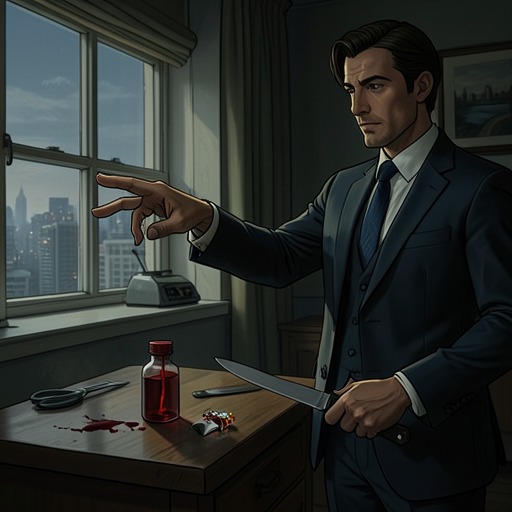
Helen’s failed attempt to kill Will
The RadleysHelen Radley’s failed attempt to kill Will Radley turns a planned act of violence into a confrontation with the desire that has bound them since Paris. In the kitchen, Helen recognizes that she still craves Will, but recognition does not give her control: when she has the chance to use a knife, her resolve gives way. Will leaves alive, while the encounter sends both characters toward separate consequences—Helen remains with the aftermath, and Will discovers that a letter and photograph connected to Rowan Radley are missing from his camper van.
Context and Stakes
Will frames Helen’s abstainer life as a performance, invoking Peter’s description of ordinary existence as a play and urging her to recover what he calls the truth of feeling. His appeal is not simply an argument about appearance. It presses on the history Helen shares with him and on the blood craving she has spent years resisting. The second edition of The Abstainer’s Handbook states that blood magnifies cravings rather than satisfying them, a principle that gives the scene its central danger: renewed contact may deepen the desire it seems to relieve.
Helen’s position is further complicated by the fact that she has been blackmailed and is under pressure from the police. When Will leaves her plea unanswered later in the scene, she tries to explain that pressure, but it does not change what has already happened between them. Her attempt therefore carries two opposed purposes: she wants to act against Will, yet she remains emotionally and physically susceptible to him. The conflict is not resolved by her understanding of the danger; it turns on whether she can act despite it.
The Kitchen Confrontation
As Will speaks, Helen handles a bread knife. She cuts her finger while slicing bread, and Will takes hold of her wrist and places the injured finger in his mouth. Helen closes her eyes. The brief contact precedes her acknowledgment that she wants to taste his blood again. Will appears surprised by her admission and asks whether she is sure; she confirms it. The scene shifts from persuasion to action, with Helen’s candor making the danger more immediate rather than dispelling it.
Will cuts his wrist, and Helen drinks from him. Their exchange becomes a kiss in which each tastes the other’s blood. Helen experiences the moment as the release of emotions she has tried to contain, but that release does not restore the earlier relationship or erase the years between them. The pleasure is accompanied by sadness and by her awareness that Clara could come downstairs and find them. The scene places intimacy and threat together: Helen is close enough to Will to attempt to kill him, but that closeness is also what makes her unable to follow through.
The Failed Attempt
While Will bites her neck, Helen reaches for the bread knife and positions it behind him. She gradually brings the blade nearer, trying to turn the private moment into an opportunity to kill him. Her hesitation is presented as an active struggle: she tries to command herself, but cannot make her hand complete the movement. At last her grip slackens and the knife falls to the floor. The attempt fails before Will is killed, and Helen is left angry and afraid that she has betrayed both her stated purpose and herself.
Will understands what she intended. Helen tries to tell him she acted under blackmail, but he says nothing and leaves the house. His departure ends the confrontation without reconciliation or a renewed promise between them. For Helen, the failed attempt has an immediate practical aftermath as well as an emotional one: she must remove the traces from the kitchen before anyone sees them. She tears sheets from a roll of kitchen paper to clean the floor, then convulses with tears. The action she had planned does not free her from Will; it leaves her alone with the consequences of having wanted him and failed to kill him.
The Missing Keepsake and Aftermath
At the same time, Will searches the back of his camper van for his most prized possession: the memory of the night in Paris as he has preserved it. He reaches for a sleeping bag where he expects to find it, but discovers only its padding. The shoebox is open, and a letter and photograph lie on the floor. The photograph shows Rowan at four years old. Will studies the child’s face and reads it through his own hostility, seeing a rival for Helen’s affection rather than innocence.
The discovery redirects Will’s attention from the failed encounter to Rowan. He leaves the van, runs up Orchard Lane, and flies toward Thirsk. He does so despite sensing Jared Copeland’s blood nearby. The parallel aftermath sharpens the event’s consequence: Helen stays behind to conceal what happened, while Will abandons the search for the keepsake and moves rapidly toward Rowan. The scene thus joins a private failure of will to a larger family danger without showing that danger resolved here.
Significance
The episode makes abstention’s central tension concrete. Helen knows that her desire is dangerous and has prepared to act against the person who awakens it; nevertheless, contact with Will overwhelms the intention she has formed. The dropped knife is the decisive reversal: the threat to Will ends, but the conflict within Helen remains. The handbook’s warning that blood intensifies craving is borne out not as an abstract rule but through the event’s sequence of renewed contact, confessed desire, and failed resistance.
The open shoebox extends that reversal beyond the kitchen. Will’s fixation on the remembered Paris night is interrupted by the photograph of Rowan, and his response changes the direction of his immediate action. The event therefore leaves two unresolved threads in motion: Helen’s attempt has failed, and Will is heading toward Thirsk after finding the evidence connected to Rowan. Neither departure amounts to closure; the encounter instead exposes how attachment, craving, and family rivalry continue to shape what the characters do next.